Writing
'Wild Soul; 7 steps to get back to yourself and your world'
I'm currently writing a seven week, step-by-step, ‘things to try’ programme - a new book, podcast and more - sharing how Nature helps me deal with the often frantic demands of our modern world, and ways to rediscover vital spark, happiness and well-being. Maybe it can work for you too.
Here's a short taster:
Silence can be restful, soothing even, but this is not that kind of silence. In the deep woods the silence is so profound I can hear my own breath. It’s unnaturally quiet, watchful, a silence where you feel seen, one where you hear your own heartbeat. Earlier, in an impulsive moment, I had pushed through the deep pines along the Hayden River, trying to spot the injured bison I'd seen from afar. I had glimpsed it upstream, motionless in the middle of the water, and it seemed to gaze back at the flanking trees with an alarmed expression. It was a gaze that spoke of danger and I wanted to know why; so following a hunch, and feeling too motivated by curiosity to think carefully, I strode forward. Maybe this bison had been attacked I wondered, maybe it's trying to evade a grizzly bear or some wolves? Maybe in the midst of the river torrent it felt safe? I’d certainly witnessed such things before: elk dashing towards the heart of a lake to escape from a wolf pack; white-tailed deer crossing a river to stay distant from black bear; but such things I'd previously seen from afar.
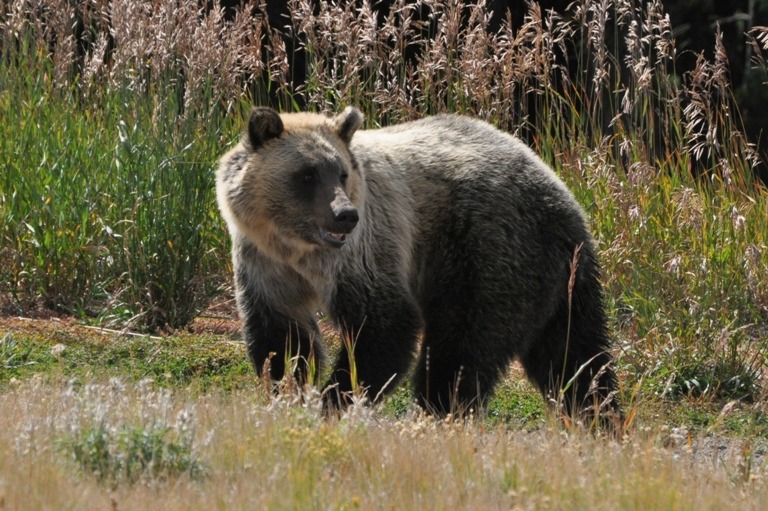
Not this time. This time I was up-close and soon I knew I'd made a mistake. Quite suddenly, there in front of me, was a bear; a close bear, a large bear, a rippling-furred grizzly bear, padding across the path, looking away from me. A shaggy, golden humped barrel of muscle, it was moving the way they often do: apparently aimless, heavy, awkward, like an ageing boxer shuffling casually and loose-limbed around the ring. This stumbling gait however is deceiving; a grizzly can out run a galloping horse if it chooses. I was sure it hadn't seen me, but its head regularly pointed to the sky as it walked, alert; a point-nosed silhouette trying to catch scent on the wind. It was searching for something and I knew I was in the wrong place at the wrong time. As the bear slipped into the pines ahead of me, headed to my right, I weighed up my options with a sinking heart and a rising pulse rate. I couldn’t see the bear now, I didn’t think it had seen me, but it was abundantly clear to me that I needed to get out of there as fast as possible, without being seen, smelled or heard. But slowly Ian, slowly and carefully, I said to myself, in an internal whisper, in my head, not out loud. I needed to be the opposite of loud. I needed to be more silent than I had ever been in my life, and I stepped back, feeling more alert and alive than I'd felt at any time before. Ever.
“You need to get real” is the phrase that's lodged in my memory even now, and it came, not as a result of all this but at the conclusion of a family gathering many years later. This was a different time and a different place, as I stood amongst a cluster of friends and relatives at a family gathering in London. I had just shared my view that what I thought we all needed was to experience more of the joy of being immersed in wild nature; how it can make us feel real and alive again. What I got back from my companions was a great deal of pushback, accompanied by something along the lines of 'you're ducking the responsibilities of living in our busy modern world', and thrown in too was that 'a proper grown-up would never get anywhere with this kind of attitude'. This gist was they believed I was advocating for escapism from the real world, pure and simple. And I hadn’t even mentioned the bear.
Alone later, I pondered this feedback with a reflective tilt of my head. As a smartphone-owning, video-streaming, online-shopping human I thought, it’s hard to feel like I inhabit a world of escapism from the modern world. But then again, I wondered, maybe doing all of those things is exactly that; it's own form of escapism.
You could say that moments like that have led me to moments like this one; setting down my thoughts, unearthing problems and digging for answers. It seems to me that the whole world has been persuaded in recent decades that we need to ‘get real’, but without much sense of stopping to examine where ‘getting real’ has gotten us. “Better dentistry but more unhappiness” is a phrase that’s been used in relation to the benefits of modernity, and whilst none of us can understate the advantages of today’s healthcare in transforming people’s lives, as the dentistry phrase implies, it's come at a cost. Here, in my view, are a few of the bigger price tag items:
Unhappiness. The causes of this in the modern Western world are manifold: overly busy lives, astonishing amounts of screen time, children spending less time outside than most prison inmates receive, big family responsibilities battling long work hours, the worry of finding work or a place to live, the cost of living, the relentless march of technology, the threat of war and conflict, the fear of planetary breakdown etc. These are just some that come to mind; your list may have others.
Stress. For most wild animals, stress is generally episodic, scary, immediate but over relatively quickly, for example fleeing when from a predator. However, for us modern humans stress is often chronic; continuing over an extended period or frequently recurring (see the list above). Most wild animals are less susceptible than humans to chronic stress-related disorders; it’s easy to imagine the same was true for our ancient ancestors.
Anxiety. We live now in an epoch of astonishingly rapid social and technological change, and humanity is experiencing unprecedented levels of chronic stress, mental health issues, damaged well-being, loneliness and a sense of futility. Perhaps the greatest problem the modern world presents to people is an increasing sense of becoming a human doing, rather than a human being; that we don’t live in our world, we exist in it.
So why is this so? How do we contain this overload? What might be the deep-seated root causes? And can we tackle them? For society, but more presciently for each of us, for our own well-being. As a remedy, is wild nature nothing more than an escape?
"We were together. I forget the rest." ~ Walt Whitman
We have a human desire to belong, to fit somewhere. Loneliness and a sense that our lives are inconsequential, both of which we’ve talked about above, seem to me to derive from us turning our backs on relationships. Relationships with other people of course, but also with all the other creatures that we share space with, and with the land we walk on or the waters we live by. In the modern Western world we’ve tried for many centuries to outgrow loneliness through developing more technology, focusing on ourselves - in recent history taking ever more selfies for example (has there ever been a more self-regrading species?) and by acquiring ever more possessions. And what have we learned through all this? That it doesn’t work. It doesn't make us feel less lonely or make us any more happy. In addition, our culture has disregarded, or certainly looked down on, other, older cultures that seem to relate to Nature more than ours; those who favour relationships rather than more ‘stuff’, and who those don't seem as lonely or unhappy. We in an ‘advanced’ culture comfortably believe we’ve outgrown these cultures, regarding ‘primitive’ attitudes to creatures, place and spirit as unproductive; escapism even.
Yet I want to suggest that perhaps, after all, greater intimacy with people, creatures and place could actually be the key to unlocking the isolation we've put ourselves in. It's easy to see how people from a culture like ours, that no longer highly value relationships - especially a relationship with something as foundational as Nature - can end up with the haunting thought that life is meaningless. Traditional people however go to extraordinary lengths to maintain a relationship with that world outside, and when we ask them about that they tell us it helps them maintain their physical and spiritual needs. In short, they have a relationship with everything that’s outside in order to nurture what’s inside. In today's terms, we may feel more comfortable describing this as therapeutic - a Nature cure, forest bathing, the science of how nature boosts our health and well-being - but in an older language, a shaman would say it’s how we stay in our Power.
There is, naturally, also a science to this. There are decades now of hugely impressive research papers that explore the hard science behind Nature’s importance to us; and how we can have better, happier, healthier and longer existence as a result of bringing it into our lives. Some people like to work with ‘hard facts’ and use the left side of their brain - analytical, logical, verbal - while some don’t need that and use the right side, the creative, emotional, visual, sensing side. In modern Western society we took that scientific method, and the things we created using it, and in a way we became them. It's as if we created a spanner, and in the process made ourselves into one, so all we can see now are things that need fixing with spanners. Quantum Physics uses the biggest spanner we ever made, the Hadron Large Collider, to smash apart particles at the tiniest level in the universe to try to understand why it behaves in the strangest ways; entangled and seemingly determined by our intentions. The science of what is on the edge of our understanding - the everyday placebo effect, the mystery of consciousness, the power of will and intention - runs directly into the stories and wisdom shared by ancestral and indigenous knowledge. In their view there’s Spirit, and in the modern West there’s Science, implying a sharp division. Yet some scientists, marginalised but using the rigour of the scientific method, are seeing that what we call spirit can be quantified; even with a spanner.
Left brain? Right brain? In my view both are fine. Perhaps the better question to ask ourselves is which of these techniques work best for us. Do we each need to follow the evidence trail, look to our bodies and my intuition, learn from ancestral and indigenous knowledge, or explore other routes? Or maybe it's a mix of all of the above? When one is feeling lost then the invitation really is to choose for yourself the best route to find your way again.
Whatever method you choose - and I favour the mix method - I'm absolutely certain that it starts with all the ways we can best have a conversation with Nature and remove the barriers we've erected; barriers between ourselves and all other living things, between ourselves and other people, between ourselves and, well, ourselves. To better know Nature, and for it to know us, is the key for each of us to feel that we are necessary in the world, that we are needed, that we are welcome, that we belong. To know and be known, to get our emotional needs met, to find meaning and purpose, to leave behind loneliness and reclaim happiness; we can think of this as therapy, or we can think of it as getting back to some forgotten deep part of ourselves.
I think Nature wants us back, and it's clear that Nature is open to being known by us - through science, spirituality or other - and I found that the more I put into that relationship the more I grew to know myself too. Traditional peoples built - and still build - relationships with Nature, and here are seven ways I believe we can try finding our way back to Nature and to ourselves:
Walking: easing in but in an unfamiliar way, being fully present and alert, not letting your thoughts be someplace else while you do, placing your feet as an animal or ancestor would have done, feeling alive; it's how you walk not how far you walk.
Speaking: then to stop having a one-way conversation with yourself and start relationships, to have conversations with what you meet, and as unfamiliar and self-conscious as it might feel, to talk out loud with the creatures and things you encounter.
Listening: of course what follows speaking is being quiet and truly listening, being respectful, just as you would in any important relationship, and taking the time to hear what is being said; it begins by saying ‘who are you?’ and waiting for an answer.
Looking: and learning to see in new ways, looking for patterns rather than labelling things or seeking answers, seeing things you might ordinarily miss and discerning natural rhythms and seasonal cycles; it all makes a big difference to your sense of awareness.
Feeling: using your intuition; a bird book won’t tell you that but your heart will for example, tuning in to feeling can rewire the brain and help you be calm - especially by going out in the dark, asking deeper questions and imagining more vividly that way.
Eating & drinking: wild food - letting Nature inside you - is the ultimate breakdown of barriers; it’s an acutely intimate thing, but with food we’ve become thoughtless about what it means. “When you drink the water, remember the spring” ~ Chinese proverb.
Making & ritual: and finally ceremonies are already a huge part of modern life - baby showers, birthdays, funerals, weddings - so creating, or leaving, gifts, lighting a candle, or doing something meaningful shows your intention and reaches out.
When we bring each of these steps to life - go out each week and try them on for size, out in Nature, focusing on how they make us feel - they can have a surprisingly big impact on us. Of course they are unfamiliar and we might feel a bit self-conscious doing them, but in my experience - especially when we bring them all together - they revive all sorts of amazing things in us such as inner calm, our creative spark, renewed zest for life or a growing spiritual awareness. They encourage us to question what we thought we knew for certain, and we receive some surprising answers, as we each uncover our own hidden depths and hidden layers in the world around us. They are actual, real, practical exercises you can use to track down peace, passion and your wild soul
I will be exploring and sharing these techniques in Wild Soul; 7 steps to get back to yourself and your world, and it forms a powerful seven-step programme that helps find what you may have lost. Just as our ancestors told us, to be in relationship to people, place and fellow creatures is powerful. By going outside we find, and get back what, was missing inside.

SAY HEY!
E: wildsoul@ianrowlands.com